If you’re a Filipino Engineering student, you’ve probably experienced this before:
You promise yourself that you’ll review your lecture notes after class. But after a long day of lectures, laboratory work, commuting, and assignments, you tell yourself, “Bukas na lang.”
Tomorrow comes, and the same thing happens.
Before you know it, prelims or finals week arrives. You’re stuck cramming multiple chapters of Engineering Mathematics, Mechanics, Thermodynamics, or Circuit Analysis in a single night. Stress levels shoot up, sleep disappears, and confidence takes a hit.

The frustrating part is that most students don’t fail because they’re not intelligent enough. Engineering students are capable people. The real challenge is maintaining consistent habits when motivation disappears.
The difference between struggling students and successful students is often much smaller than it seems.
One of the most powerful ideas you can learn is this:
The things that are easy to do are also easy not to do.
Reading 10 pages? Easy.
Reviewing lecture notes for 15 minutes? Easy.
Solving three extra practice problems? Easy.
Skipping them? Also easy.
And that’s exactly why these small actions create such a massive difference over time.
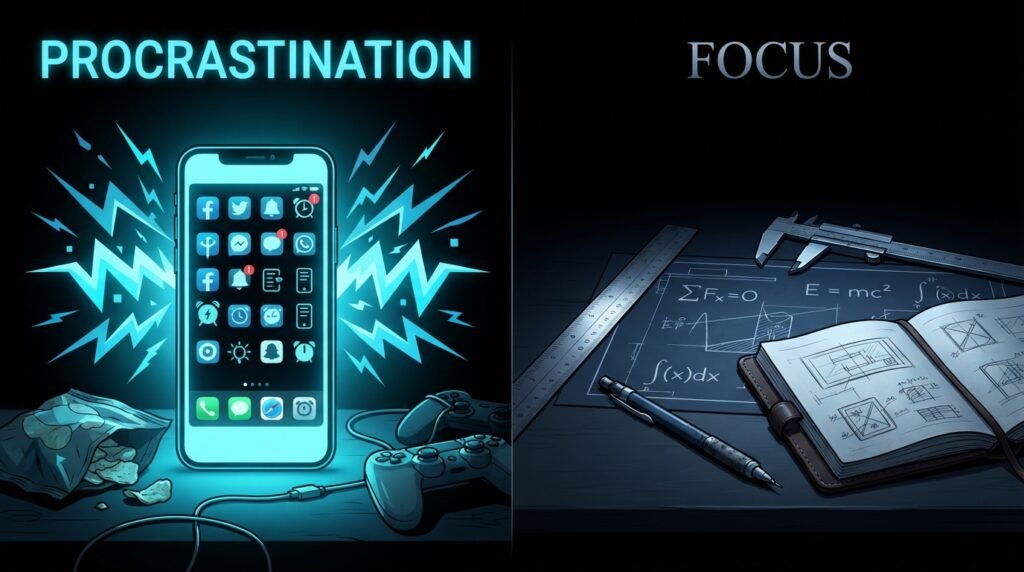
Understanding the Real Problem
Many Engineering students believe their biggest challenge is difficult subjects.
While Engineering courses are certainly demanding, the real problem is often inconsistency.
Students frequently make the mistake of relying on motivation instead of habits.
They wait until they “feel motivated” before studying.
They wait until exams are near before reviewing.
They wait until deadlines become urgent before starting projects.
Unfortunately, motivation is unreliable. Some days you’ll feel energized and productive. Other days, you’ll feel tired, stressed, or distracted.
If your success depends on motivation, your results will always be inconsistent.
Another common misconception is believing that dramatic effort creates dramatic results.
Many students think:
- “I’ll study 10 hours this weekend.”
- “I’ll review everything before the exam.”
- “I’ll catch up next week.”
The problem is that massive effort done occasionally rarely beats small effort done consistently.
Think about two students:
Student A studies intensely for 8 hours before an exam.
Student B studies just 30 minutes daily for several weeks.
Who usually performs better?
Most of the time, Student B has the advantage because learning accumulates gradually. Concepts become easier to understand, retention improves, and stress remains manageable.
Successful students don’t become successful because they do extraordinary things once.
They become successful because they do ordinary things repeatedly.

The Shift That Changes Everything
The habit that separates successful students from average ones is not intelligence.
It’s not having perfect study techniques.
It’s not buying expensive gadgets or enrolling in multiple review programs.
It’s consistency.
This is what many personal development experts call the Slight Edge Formula:
Small daily disciplines + Time = Massive Results
At first, the results seem invisible.
A 15-minute review session doesn’t feel life-changing.
Reading 10 pages of a textbook doesn’t feel extraordinary.
Solving a few problems every day doesn’t seem significant.
But when these actions are repeated day after day, week after week, month after month, they create a powerful advantage.
Let’s look at an example.
Imagine you’re taking Engineering Mathematics.
Instead of waiting for exam week, you spend just 20 minutes reviewing formulas and solving two practice problems every day.
After 30 days, you’ve:
- Reviewed lessons multiple times
- Strengthened your understanding
- Identified weak areas early
- Reduced exam anxiety
- Built confidence in solving problems
The best part?
You never needed marathon study sessions.
Practical Steps You Can Start Today
1. Choose One Small Habit
Don’t try to change everything at once.
Pick one habit that’s impossible to ignore.
Examples:
- Review lecture notes for 10 minutes daily
- Solve 3 practice problems every day
- Read 5 to 10 pages of your textbook
- Prepare tomorrow’s tasks before sleeping
Start small enough that excuses become difficult.
2. Connect It to an Existing Routine
Attach your habit to something you already do.
For example:
- Review notes after dinner.
- Read one section before sleeping.
- Solve problems after your last class.
This makes the habit easier to remember.
3. Track Your Progress
Use a notebook, planner, calendar, or phone app.
Mark every day you complete your habit.
There’s something powerful about seeing a streak grow.
After a few days, you’ll want to protect the streak.
4. Focus on Consistency, Not Perfection
Missed one day?
Don’t quit.
Don’t wait for Monday.
Don’t wait for next month.
Simply continue the next day.
Successful students aren’t perfect.
They’re just better at getting back on track.

From Struggling Student to Confident Achiever
The transformation begins quietly.
At first, nothing dramatic happens.
You may not suddenly become the top student in your class.
But week by week, things start to change.
Your lectures become easier to follow because you’ve already reviewed previous lessons.
You spend less time trying to relearn forgotten concepts.
You become more prepared during quizzes.
Assignments feel less overwhelming.
Most importantly, your confidence grows.
Many students think confidence comes before action.
The truth is the opposite.
Confidence comes from keeping promises to yourself.
Every day you show up and complete your chosen habit, you’re proving something important:
You are becoming the kind of person who follows through.
This mindset doesn’t only help in school.
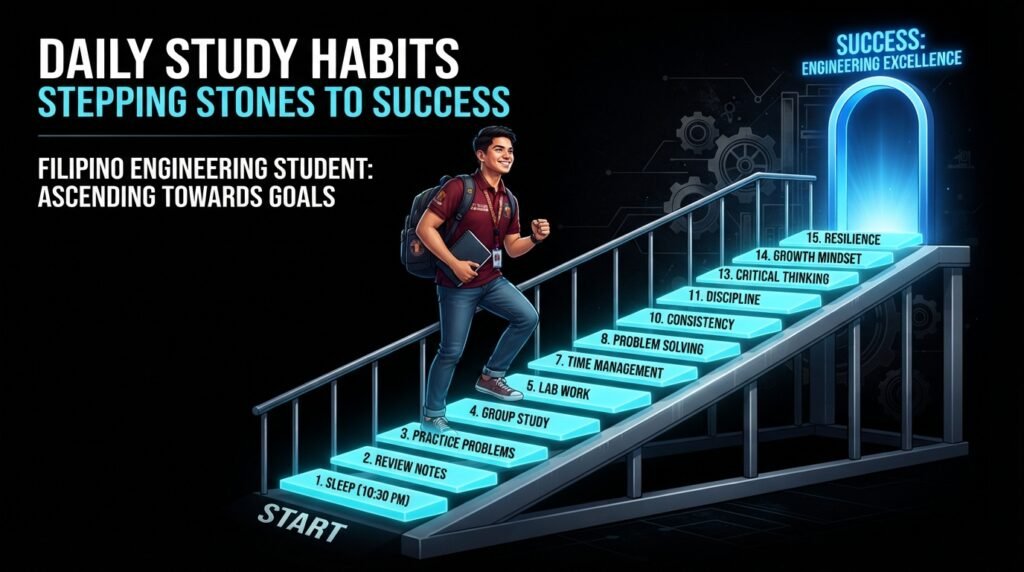
Engineering careers demand discipline, problem-solving, consistency, and continuous learning.
The habits you build today will help you:
- Pass challenging courses
- Perform better during internships
- Prepare for board examinations
- Excel in future engineering roles
- Handle pressure more effectively
Over time, you’ll notice that the gap between you and other students isn’t based on talent.
It’s based on daily choices.
While others wait for motivation, you’ll already be making progress.
While others cram, you’ll review calmly.
While others feel overwhelmed, you’ll feel prepared.
That’s the power of consistency.
Conclusion
The difference between successful students and average students is often much smaller than people think.
Success is rarely the result of one big decision.
It’s usually the result of many small decisions repeated every day.
Remember this principle:
The things that are easy to do are also easy not to do.
Reading 10 pages is easy.
Reviewing lecture notes is easy.
Practicing a few problems is easy.
But because they’re easy, many students skip them.
The students who succeed are the ones who choose to do them anyway.
The Slight Edge Formula is simple:
Small daily disciplines + Time = Massive Results
You don’t need a perfect study system.
You don’t need endless motivation.
You don’t need to become a different person overnight.
You simply need to choose one habit and commit to it consistently.
Your 30-Day Challenge
Pick ONE habit.
Do it every day for the next 30 days.
No excuses.
Not because it’s difficult.
But because your future self deserves the results that consistency creates.

Call to Action
Unlock Your Potential with DISKARTE UNLOCKED
If you’re ready to stop relying on motivation and start building habits that produce real academic results, DISKARTE UNLOCKED is your practical guide to becoming a more disciplined, focused, and successful student.
Inside the book, you’ll learn how to:
- Build effective and sustainable study habits
- Develop self-discipline even when motivation is low
- Improve productivity without burning out
- Strengthen your mindset during academic challenges
- Overcome procrastination and self-doubt
- Unlock your full academic and personal potential
Whether you’re struggling to keep up with Engineering subjects or simply want to perform at a higher level, DISKARTE UNLOCKED provides actionable strategies you can apply immediately.

Free Resource for Students
Not ready to get your copy of DISKARTE UNLOCKED yet? Download the free e-book, 7-Day Detox Diskarte, and discover simple strategies to improve your focus, productivity, and study habits starting today.
Remember: Your future is not shaped by what you do once in a while. It is shaped by what you do consistently every single day. Start small, stay consistent, and watch your life change.
References
Rawson, K. A. & Dunlosky, J. (2022). Successive Relearning: An Underexplored but Potent Technique for Obtaining and Maintaining Knowledge. Psychological Science 31(4). https://doi.org/10.1177/09637214221100484
Credé, M. & Kuncel, N. R. (2008). Study Habits, Skills, and Attitudes: The Third Pillar Supporting Collegiate Academic Performance. Perspectives on Psychological Science 3(6), pp. 425-453. https://doi.org/10.1111/j.1745-6924.2008.00089.x
Aulagnon, R., Cristia, J., Cueto, S. & Malamud, O. (2026). Streaks to Success? The Effects of Highlighting Streaks on Student Effort and Learning. WP-26-05. https://doi.org/10.2139/ssrn.4261234
Wood, W. & Rünger, D. (2016). Psychology of Habit. Annual Review of Psychology 67, pp. 289-314. https://doi.org/10.1146/annurev-psych-122414-033417
Kanngiesser, P., Serko, D. & Woike, J. K. (2023). Promises on the go: A field study on keeping one’s word. Frontiers in Psychology 14. https://doi.org/10.3389/fpsyg.2023.1097239
Jonassen, D. H. (n.d.). Engineers as Problem Solvers. https://www.cambridge.org/core/books/abs/cambridge-handbook-of-engineering-education-research/engineers-as-problem-solvers/DF05C614667600BD6193FE2E10CA398D
Related Posts

HOW TO GET CLOSER TO YOUR DREAMS AND DISCOVER YOUR BEST LIFE. LEARN IT FROM THE POWER OF ONE MORE BOOK BY ED MYLETT
"You're a lot closer to changing your life than you…

HOW GREAT ATHLETES THINK, TRAIN, AND THRIVE. SUMMARY OF THE CHAMPION’S MIND BOOK BY JIM AFREMOW
"The difference between a pedestrian performance and a peak performance…

HOW TO HAVE MEANINGFUL CONNECTIONS. INSIGHTS FROM ATLAS OF THE HEART BOOK BY BRENE BROWN.
"If you want to go fast, go alone. If you…